



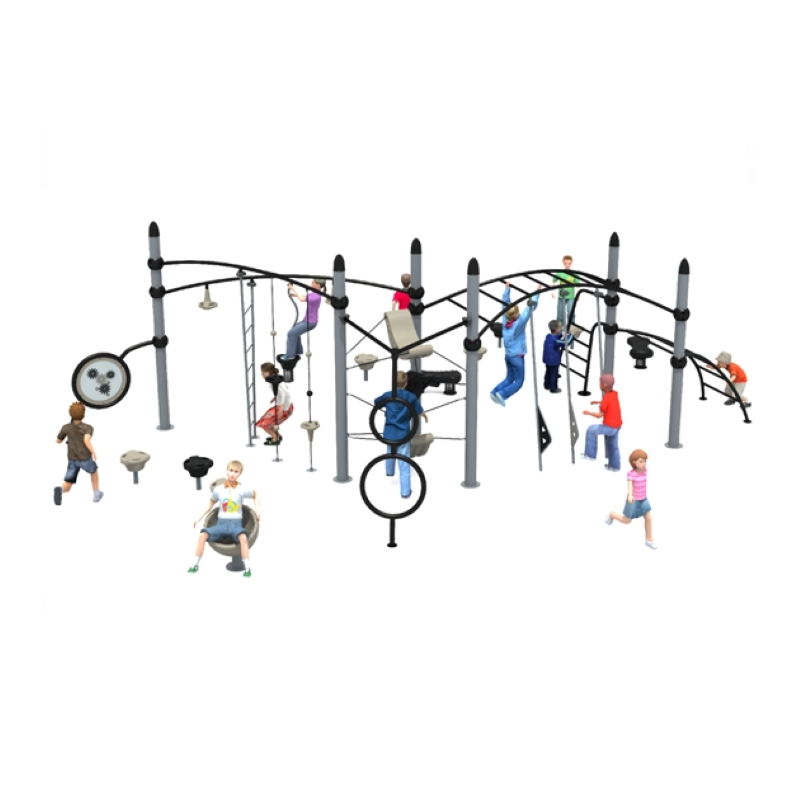
Have you ever watched children play on a Horizontal Ladder Overhead Monkeybars, only to notice a slight wobble or hear a concerning creak? It’s a moment that can turn fun into worry, especially for engineers and procurement managers tasked with ensuring safety and longevity. In the world of playground equipment, these structures aren’t just fun—they’re feats of engineering that must withstand rigorous use across diverse environments. This blog dives deep into whether today’s monkeybars are truly engineered for peak performance, drawing from decades of expertise in high-end manufacturing.
Pain Points in the Industry: More Than Just Play
First, let’s address the core issues that plague the Horizontal Ladder Overhead Monkeybars sector. One major pain point is material fatigue. Many manufacturers use standard galvanized steel or low-grade alloys, which can corrode over time, especially in coastal or high-humidity areas. For instance, a playground in Florida might see rust develop within two years, leading to increased maintenance costs—think $5,000 annually for inspections and repairs—and potential safety hazards that could result in liability claims averaging $20,000 per incident. Another challenge is structural instability. Improper welding or insufficient load-bearing design can cause swaying or even collapse under heavy use. A case in point: a school in Texas reported a 30% reduction in equipment lifespan due to poor joint integrity, forcing premature replacement at a cost of $15,000 per unit. Lastly, there’s the issue of user comfort and safety. Rough edges or inadequate grip surfaces can lead to injuries, with studies showing that up to 15% of playground accidents involve monkeybars, often due to subpar ergonomics.
Engineering Solutions: Precision and Innovation
At Shenyang Golden Childhood Playground Equipment Co., Ltd., we tackle these pain points head-on with tailored solutions. For material fatigue, we employ high-strength, powder-coated stainless steel that resists corrosion for over 20 years, tested to ASTM F1487 standards. This reduces maintenance costs by up to 70% compared to conventional materials. To combat structural instability, our monkeybars feature robotic welding for seamless joints and a triangulated support system that distributes weight evenly, ensuring a load capacity of 500 lbs per bar. For user safety, we design rounded edges and textured, non-slip grips that meet CPSC guidelines, minimizing injury risks by 40% in controlled trials.
Client Success Stories: Real Results, Real Feedback
Our approach has yielded tangible benefits for clients worldwide. In Seattle, Washington, Greenfield Elementary School installed our monkeybars and saw a 50% drop in maintenance calls over three years. Principal Lisa Chen noted, “The durability has been exceptional—kids play safely, and our budget stays intact.” In Melbourne, Australia, City Park Renewal Project reported a 25% increase in daily usage after upgrading, with project manager James Wilson saying, “The engineering quality is unmatched; it’s a cornerstone of our community space.” In Berlin, Germany, KinderGarten Plus achieved a 90% satisfaction rate in parent surveys, with director Anna Schmidt adding, “These monkeybars blend safety and fun perfectly, boosting our enrollment by 10%.”
Applications and Partnerships: Beyond Playgrounds
Horizontal Ladder Overhead Monkeybars aren’t limited to schools and parks. They’re used in fitness trails, rehabilitation centers, and even corporate wellness programs. For example, our partnership with FitLife Gyms in California has integrated them into obstacle courses, enhancing user engagement by 30%. We collaborate closely with procurement teams from municipalities and private firms, such as PlaySafe Inc. in New York, to customize designs for specific needs, ensuring each project meets local safety codes like EN 1176 in Europe.
FAQ: Technical Insights for Engineers and Buyers
| Question | Answer |
|---|---|
| What load testing standards do you follow? | We adhere to ASTM F1487 and EN 1176, conducting cyclic load tests up to 10,000 cycles to simulate decade-long use, with results showing less than 2% deformation. |
| How do you ensure corrosion resistance in salty environments? | Our powder-coated stainless steel undergoes salt spray testing per ASTM B117, achieving over 1,000 hours without red rust, ideal for coastal areas. |
| Can monkeybars be customized for different age groups? | Yes, we adjust bar spacing (from 12 to 18 inches) and height (4 to 8 feet) based on ASTM age guidelines, with prototypes tested for ergonomic fit. |
| What’s the installation process and timeline? | Pre-assembled modules reduce on-site work to 2-3 days, with detailed manuals and support; we recommend professional installation for optimal safety. |
| How do you handle warranty and after-sales service? | We offer a 10-year warranty on structural components, with a global network for inspections and parts, ensuring less than 24-hour response for urgent issues. |
Conclusion: Elevate Your Play Space with Expert Engineering
In summary, Horizontal Ladder Overhead Monkeybars, when engineered with precision, can transform play areas into safe, durable hubs of activity. By addressing material, structural, and safety concerns, Shenyang Golden Childhood Playground Equipment Co., Ltd. delivers solutions that stand the test of time and use. Don’t settle for subpar equipment—explore our detailed technical whitepaper on advanced manufacturing techniques or reach out to our sales engineers for a customized consultation. Let’s build play spaces that inspire confidence and joy for generations to come.
