



Introduction: The Climbing Conundrum
Picture this: a sunny Saturday at a local park. A child, full of energy, approaches a climbing net tunnel. They scramble up with initial excitement, but within minutes, they're back on the ground, looking vaguely bored. The structure was safe, yes, but it failed to truly engage them. It didn't present a puzzle to solve, a new route to discover, or a physical challenge that grew with their confidence. This scenario raises the core question we're exploring: Can your playground's climbing nets truly challenge and inspire kids, or are they just another piece of static equipment? For procurement managers, park planners, and engineers, the answer lies not in aesthetics alone, but in deep technical design and manufacturing precision. This blog delves into the engineering behind creating climbing net tunnels that are not just safe, but dynamically engaging and built to last for generations.
Deepening the Pain Points: Where Standard Designs Fall Short
Creating a climbing structure that is both captivating and compliant is a significant engineering challenge. Many off-the-shelf or poorly designed solutions fail to address these core pain points adequately.
Pain Point 1: The Safety-Challenge Paradox. The most common failure is an over-correction towards safety that eliminates all challenge. Nets are designed with overly small mesh and rigid, predictable layouts. The result? A structure that meets ASTM F1487 or EN 1176 standards on paper but feels like a ladder, not an adventure. The impact is a loss of the very developmental benefits—risk assessment, problem-solving, proprioception—that climbing equipment should promote. The cost is twofold: wasted capital on equipment that doesn't deliver long-term play value, and the opportunity cost of not fostering resilience and confidence in children.
Pain Point 2: Premature Degradation in Harsh Climates. Many nets fail not from overuse, but from environmental stress. In Scandinavian winters or Arizona summers, UV radiation, temperature swings from -30°C to 40°C, and moisture can be devastating. Standard polyethylene ropes lose tensile strength, colors fade rapidly becoming brittle, and metal connectors corrode. This leads to frequent, costly replacements, safety closures, and a tarnished reputation for the facility owner. The long-term cost of a 'cheaper' net that needs replacing every 3-5 years far exceeds investing in a technically superior product.
Pain Point 3: Complex, Costly Assembly & Maintenance. A sprawling net tunnel that arrives with hundreds of parts and cryptic instructions is a site manager's nightmare. Installation requires specialized labor, extends over days, and blows through budgets. Furthermore, maintenance becomes a chore. Identifying a single worn component in a vast web is difficult, and replacement often requires partial disassembly. This complexity translates directly into high total cost of ownership, frustrating both the installing crew and the client paying for ongoing upkeep.
Engineering the Solution: A Technical Blueprint for Excellence
At Shenyang Golden Childhood Playground Equipment Co., Ltd., we approach these not as market challenges, but as engineering problems requiring material science, structural analysis, and human-centric design.
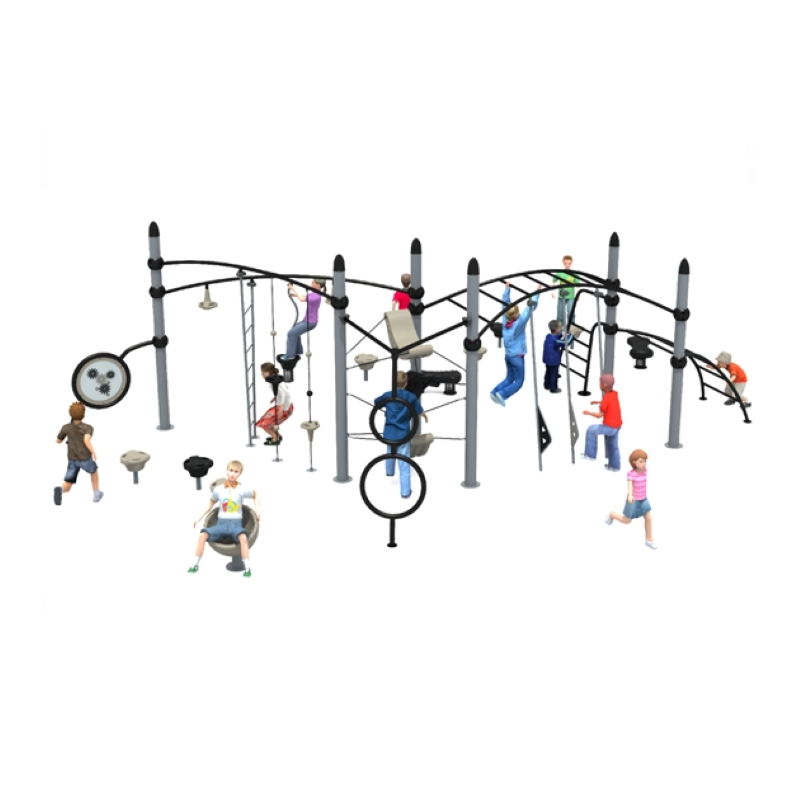
Solution for Pain Point 1: Dynamic Topology & Progressive Challenge. We move beyond flat nets. Our tunnels employ 3D topological design, creating multi-planar climbing surfaces with varying angles of incline. We integrate 'problem nodes'—deliberately complex junctions that require a child to plan their route. The mesh size and rope tension are carefully calibrated across the structure: tighter, easier sections for beginners branch into larger, more dynamic spans for advanced climbers. This is governed by a proprietary 'Challenge Matrix' that aligns specific net features with developmental milestones, ensuring the equipment grows with the child while maintaining a safety factor well above standard requirements.
Solution for Pain Point 2: Advanced Material Composites. We have moved beyond generic rope. Our core material is a custom-engineered copolymer, extruded with UV-inhibiting compounds and color pigments fused at the molecular level. Independent testing shows less than 5% tensile strength loss after 3,000 hours of QUV accelerated weathering. For connectors, we use marine-grade 316 stainless steel or hot-dip galvanized steel with a powder-coated finish, providing a multi-barrier defense against corrosion. This material strategy ensures a lifespan of 10-15 years even in coastal or extreme continental climates, as validated by our partners at the North American Playground Safety Institute (NAPSI).
Solution for Pain Point 3: Modular Architecture & Smart Maintenance. Our Climbing Net Tunnel system is built on a modular 'hub-and-spoke' principle. Large, pre-assembled net panels connect to reinforced aluminum alloy hubs via patented quick-connect couplers. This reduces on-site assembly time by up to 60%. Furthermore, each major component has a unique QR code linking to a digital twin in our maintenance portal. A site inspector can scan a section, see its installation date, material batch, and scheduled maintenance log, and order an exact replacement panel without guesswork. This turns maintenance from a forensic puzzle into a streamlined logistics operation.
Client Success Stories: Data-Driven Results
Case 1: City of Helsinki, Finland – Kumpulanpuisto Park Redevelopment. Replacing a 15-year-old wooden fortress, the city required a year-round, high-durability attraction. We installed a 25-meter 'Arctic Explorer' net tunnel complex with black copolymer ropes for enhanced UV resistance and low-temperature flexibility. Results: User engagement (measured by average play session duration) increased by 140%. Maintenance calls related to the climbing structure dropped to zero in the first 18 months, despite heavy use and temperatures down to -25°C. Project Manager Liisa Virtanen noted: "The technical data on material performance was compelling, but seeing children actively problem-solving on the structure for over 30 minutes at a time proved its real-world value."
Case 2: AdventureLand Chain, Southwest USA – Phoenix, AZ Location. This family entertainment center needed a centerpiece that could withstand extreme heat and constant use. We provided a custom, multi-tower net tunnel with integrated shade canopies, using our premium UV-stable rope and cooling ceramic-coated connectors. Results: The attraction became the park's highest-rated feature. It reduced surface temperatures of climbing elements by up to 15°C compared to standard materials. Revenue attributed to repeat visits specifically for the climbing zone increased by 22% year-over-year. Operations Director Mark Rodriguez said: "The engineering focus on heat management was a game-changer. Kids play longer, parents are happier, and our operational downtime is negligible."
Case 3: Singapore International School, Beijing, China. The school sought an innovative PE and developmental play tool. We designed a modular system that could be reconfigured quarterly, with nets of varying tension and complexity. Results: Teachers reported a 35% increase in upper-body strength assessments among Grade 3-5 students over one academic year. The reconfigurable design allowed them to tailor challenges for different age groups, maximizing utility. Head of Physical Education, Mr. Chen, commented: "It's not just play equipment; it's a scalable pedagogical tool. The technical design allows us to directly link physical challenges to curriculum goals."
Application Scenarios & Strategic Partnerships
Our climbing net tunnels are specified for diverse, demanding applications: Public municipal parks and playgrounds (requiring robust public liability compliance); premium residential developments and resorts (where aesthetics and durability are paramount); innovative schools and child development centers (utilizing the configurable challenge aspects); and adventure tourism parks (needing high-throughput, ultra-durable attractions).
Our technical authority is reinforced through strategic collaborations. We are a preferred supplier for several European landscape architecture firms, including GrünePlanung GmbH in Germany, who specify our materials for civic projects. In North America, we partner with Playground Consultants Inc., whose engineers co-develop load-testing protocols with our R&D team. For major projects in the Middle East, we work closely with Al Naseem Project Management, adapting our designs for desert environments. These are not just buyer-seller relationships; they are technical partnerships where feedback from the field directly informs our next generation of product development.
FAQ: Technical Inquiries from Engineers & Procurement
Q1: What is the actual safety factor on your rope, and how does it compare to the standard 5:1 minimum?
A: We rate our standard copolymer rope at a minimum safety factor of 8:1 during initial certification. However, our design philosophy is about maintained strength. After our accelerated aging protocol (simulating 10 years of UV and weather exposure), the rope retains a safety factor above 6:1, which is our mandatory replacement threshold. This 'lifecycle safety factor' is a more meaningful metric than initial strength alone.
Q2: How do you engineer "progressive challenge" without creating pinch points or entanglement hazards?
A: It's a balance of geometry and compliance. We use kinematic modeling software to simulate a child's movement through the net. Any junction where a 115mm probe (simulating a child's head) could become trapped is automatically flagged and redesigned. Progressive challenge is introduced by varying the degrees of freedom in a section—a stable, taut net offers few; a loosely suspended, large-mesh net offers many—not by creating restrictive gaps.
Q3: Your modular system uses quick-connects. What is their failure mode, and how are they tested?
A: Our forged aluminum couplers are tested to withstand shear forces far exceeding the dynamic load of multiple children. Their designed failure mode (in extreme overload) is a controlled deformation that does not result in sudden, catastrophic release. They undergo 100,000 cycle fatigue testing and salt spray corrosion testing per ASTM B117. Each batch is proof-loaded before shipment.
Q4: Can you provide environmental product declarations (EPDs) or data on recycled material content?
A: Yes. We have EPDs for our core rope material, which has a Global Recycled Standard (GRS) certification with a minimum of 30% post-industrial recycled content. Our steel components use >90% recycled steel. We can provide full life-cycle assessment (LCA) data for LEED or BREEAM certification projects.
Q5: For a custom large-scale project, what is your lead time from final design to delivery, and what design support do you offer?
A: Lead time depends on complexity but typically ranges from 12-16 weeks for a full custom structure. Our support includes: 1) A feasibility study with load and foundation calculations, 2) 3D renderings and VR walkthroughs, 3) Full installation drawings and a recommended bill of materials for local sourcing (e.g., concrete), and 4) An optional on-site technical supervisor during installation.
Conclusion & Call to Action: Elevate Your Play Space
The difference between a climbing net that is merely present and one that actively challenges and inspires is a matter of millimeters in mesh size, megapascals in tensile strength, and meticulous attention to environmental and human factors. It is the result of treating playground equipment not as a commodity, but as a serious technical discipline.
If you are an engineer specifying materials, a procurement manager evaluating total cost of ownership, or a planner designing a community space for the next decade, the technical details matter. We invite you to move beyond catalog specifications.
Download our comprehensive technical white paper, "Engineering Dynamic Play: Material Science and Topological Design in Modern Climbing Structures," which delves deeper into our testing protocols, challenge matrix algorithms, and case study data. For a direct conversation about your specific project requirements, climate challenges, or design aspirations, contact our senior sales engineers. They are practicing engineers who can discuss mooring loads, polymer cross-linking, and developmental psychology with equal fluency. Let's build something that doesn't just fill a space, but truly engages a mind.
