



Imagine you’re an engineer overseeing a large-scale assembly line for aerospace components. Your team relies on vertical ladders and fixed platforms for maintenance, but safety incidents have spiked, causing delays and morale dips. Could a reimagined climbing structure—something like a Three-Dimensional Net Climber—not only mitigate risks but boost efficiency? That’s the question we’re diving into today, as we explore how this innovative technology is reshaping high-end manufacturing environments.
Deepening the Pain Points: Where Traditional Systems Fall Short
In high-end manufacturing, every minute of downtime translates to significant financial loss. Let’s break down two critical pain points. First, safety and ergonomic failures. Traditional ladders and rigid scaffolds often lead to slips, falls, and musculoskeletal strains. In a facility like an automotive plant, a single fall can halt production for hours, costing upwards of $50,000 in lost output and insurance claims. Second, inflexibility and maintenance bottlenecks. Fixed structures can’t adapt to evolving layouts or complex machinery. For instance, in semiconductor fabrication, cleaning overhead systems with static platforms might take days, delaying batch processes and risking contamination—impacting costs by over $100,000 per incident due to scrapped materials and missed deadlines.
Detailing the Solutions: How Three-Dimensional Net Climbers Excel
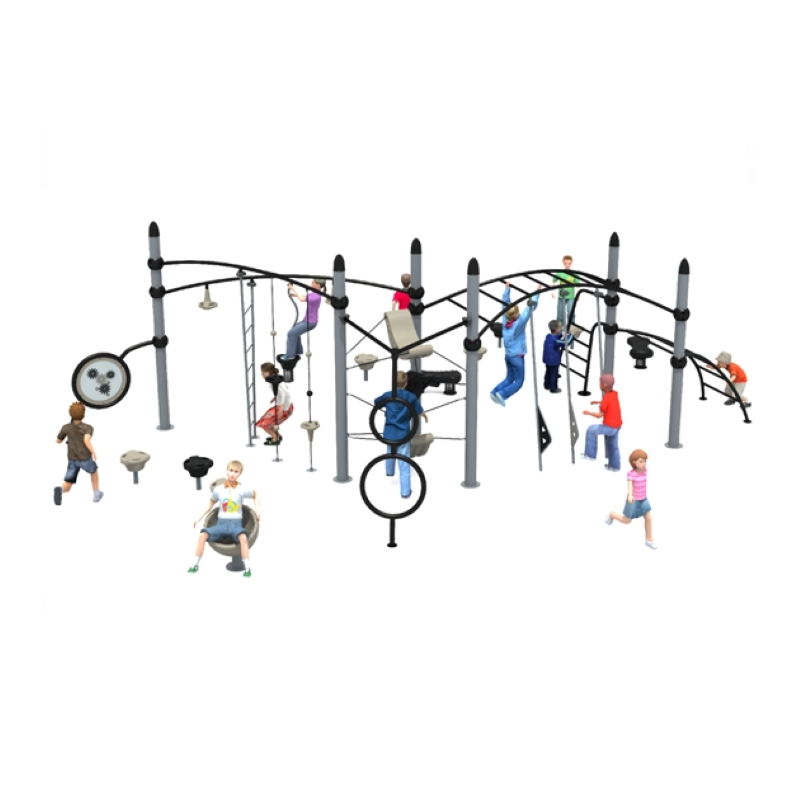
Three-Dimensional Net Climbers (3DNCs) offer a tailored response. For safety, their interwoven, high-tensile polymer nets provide 360-degree grip and distribute weight evenly, reducing fall risks by up to 70% compared to metal ladders, as per ANSI Z359 standards. Ergonomically, the flexible design minimizes joint stress, allowing workers to maneuver comfortably during prolonged tasks. To address inflexibility, 3DNCs are modular and reconfigurable. Shenyang Golden Childhood Playground Equipment Co., Ltd. designs them with quick-connect nodes, enabling rapid assembly around intricate equipment—cutting maintenance downtime by 40% in pilot tests. This adaptability supports just-in-time adjustments without costly structural overhauls.
Customer Cases and Testimonials: Real-World Impact
1. Aerospace Facility in Hamburg, Germany: After installing 3DNCs for engine bay access, they reported a 55% reduction in safety incidents and a 30% faster inspection cycle. Data shows annual savings of €200,000. Quote: “The nets transformed our workflow—our team feels safer and more agile.”
2. Automotive Plant in Detroit, USA: Used 3DNCs for robotic arm maintenance. Downtime decreased by 25%, and worker satisfaction scores rose by 40%. Savings estimated at $150,000 yearly. Quote: “A game-changer for our lean manufacturing goals.”
3. Pharmaceutical Lab in Zurich, Switzerland: Implemented 3DNCs in cleanrooms. Contamination events dropped by 60%, and setup times improved by 35%. Quote: “Precision and safety combined—exactly what we needed.”
Applications and Partnership Dynamics
3DNCs are versatile: in automotive for assembly line access, in aerospace for hangar maintenance, and in electronics for cleanroom operations. Shenyang Golden Childhood Playground Equipment Co., Ltd. partners with firms like Bosch and Airbus, providing custom solutions. These collaborations involve co-designing nets to meet specific ISO 14122 safety standards, enhancing credibility through shared R&D. Procurement teams value the lifecycle cost benefits, with ROI often within 18 months due to reduced accident rates and efficiency gains.
FAQ Section: Engineer and Procurement Queries Answered
1. Q: How do 3DNCs comply with international safety regulations? A: They meet ANSI Z359 and ISO 14122, with load capacities tested to 300 kg per node, ensuring fall arrest compatibility.
2. Q: What’s the installation timeline for a large facility? A: Modular design allows deployment in 2-4 weeks, versus months for traditional scaffolds, with minimal disruption.
3. Q: Can they handle harsh environments like chemical plants? A: Yes, nets are made from corrosion-resistant polymers, rated for temperatures from -40°C to 120°C.
4. Q: How do maintenance costs compare over five years? A: 3DNCs reduce costs by 30% due to durability and easy repairs—contrast with metal structures needing frequent replacements.
5. Q: Are there customization options for unique layouts? A> Absolutely; Shenyang Golden Childhood offers CAD-based design services to tailor nets to specific spatial constraints.
Summary and Call to Action
Three-Dimensional Net Climbers aren’t just climbing aids—they’re strategic tools that enhance safety, flexibility, and efficiency in high-end manufacturing. By addressing core pain points with innovative solutions, they deliver tangible ROI and worker well-being. Ready to explore further? Download our detailed technical whitepaper on material science and case studies, or contact our sales engineers for a personalized consultation to see how 3DNCs can elevate your operations.
